The Oscar season has arrived. This year the choice is rather stark. It could well confirm the parochial and internalised (and ultimately unethical) values of the Academy - if such confirmation is necessary. The front-runners for the best film are 12 Years a Slave, American Hustle and Gravity. American Hustle is the kind if film that Hollywood does exploitingly well - fast, funny, full of narrative action and characterful people (all over-acted). It also belongs to the genre of film in which we are seduced by charismatic crooks - like Butch Cassidy..., and Bonnie and Clyde, and the another nominated picture, The Wolf of Wall Street. Of these the Wolf stands at the extreme end of the scale, since it concerns a living crook who is clearly raking in money from being convicted of crimes. Gravity is a fine film, visually compelling and unafraid to use slow long-shots, but vitiated by the metaphysical re-appearance of the male astronaut to give Sandra Bullock life-saving instructions. Presumably, being George Clooney, they could not kill him off so early in the film.
This leaves only one choice. Please take it.
Friday, 17 January 2014


banks and bonuses
Bankers bonkers bonuses again. The two main justifications for huge pay, as for other executives, which are rolled out again are never or rarely challenged in the media.
The first is that a corporation must pay a competitive rate to obtain the services of the "best" executives. This policy has failed dramatically. The banking collapse was the responsibility if those who had been recruited and remunerated on precisely these grounds. It would be far better not to have the "best" - i.e. those macho manipulators who are paid obscene salaries - but to recruit someone less exciting who has a measured sense of responsibility.
The second is that bonuses "incentivize" (horrid word) people to work harder. Bonuses may have encouraged executives to take risks, but if employers and employees are loyal and motivated, they should not (and generally do not) work hard or less hard in direct proportion to their pay. I would not have worked 10% less hard if I had been paid 10% less, and I would not have worked 10% harder for 10% more pay. I would have been pleased to be paid more - but that is another matter.
For some years I have been a "member" of the Co-operative bank, run by a financially illiterate reverend drug-taker. This an excerpt from the letter I have written to them.
"The bank and all those responsible for its operation over the last 5 years should be in no doubt about the level of betrayal felt by its customers. I joined the bank because it was a co-operative and therefore different from other banks. The behaviour of the executive and the failure of the board to operate due diligence, not least in appointing the CEO, has been terrible even by the decayed standards of British banking.
The first is that a corporation must pay a competitive rate to obtain the services of the "best" executives. This policy has failed dramatically. The banking collapse was the responsibility if those who had been recruited and remunerated on precisely these grounds. It would be far better not to have the "best" - i.e. those macho manipulators who are paid obscene salaries - but to recruit someone less exciting who has a measured sense of responsibility.
The second is that bonuses "incentivize" (horrid word) people to work harder. Bonuses may have encouraged executives to take risks, but if employers and employees are loyal and motivated, they should not (and generally do not) work hard or less hard in direct proportion to their pay. I would not have worked 10% less hard if I had been paid 10% less, and I would not have worked 10% harder for 10% more pay. I would have been pleased to be paid more - but that is another matter.
For some years I have been a "member" of the Co-operative bank, run by a financially illiterate reverend drug-taker. This an excerpt from the letter I have written to them.
"The bank and all those responsible for its operation over the last 5 years should be in no doubt about the level of betrayal felt by its customers. I joined the bank because it was a co-operative and therefore different from other banks. The behaviour of the executive and the failure of the board to operate due diligence, not least in appointing the CEO, has been terrible even by the decayed standards of British banking.
Whatever assurance the bank may
provide, any organisation dominated by hedge funds and other financial
manipulators will clearly not have “members” welfare as its top priority.
Customer care and service will become, as it is for all banks and large
business entities, a tool of corporate self-interest rather than a goal in
itself.
I will remain with the bank for
the time being, largely because there is nowhere else to go."
Tuesday, 22 October 2013
Grayson Perry and the Reith Lectures
I started two of Perry's Reith lectures. I did not finish either.
They are full of the stench of cheery hypocrisy. As a "transvestite potter from Essex", complete with cor-blimey accent, he pretends to stand as the plain-person's scourge of art establishment, while being both part of it and absolutely dependent on it. His whole stance, artistically and personally, is designed for head-line effect in the disingenuous establishment of pseudo-transgression that is such a potent force in the art world.
I listened to some earlier interviews on line. In the older ones he finds it harder to sustain the accent beyond the opening sentences. Now he can perform "common" cackles and "working-class" tics with impeccable skill - to rival that of Nigel Kennedy. King Edward VI Grammar School, Chelmsford, seems far away.
The laddish presentation (yes, he is laddish) somehow succeeds in masking the reality of views that are ill thought-through, and often ill-informed. Just two examples. In an Art Newspaper interview (http://www.youtube.com/watch?v=uE-u9Y76Y-I) he claims that "tapestries came before oil paintings". This is simply untrue. In the late Middle Ages and Renaissance, tapestries became far more expensive than paintings in exclusive aristocratic contexts - which is not the same thing at all. Then in a Victoria and Albert Museum interview on art and craft (http://www.youtube.com/watch?v=BAdcD4ZCKak) he tells us that "painting is becoming a craft". This seems meaningless without some kind of supporting argument. Having ill-informed opinions, that are aired with chirpy assertiveness and are self-consciously designed to be contrarian, does not necessarily stop an artist from making great art-works. I think the tapestries and the pots are rather good, even if he's no Hogarth. What is not justified is that Perry should be taken as some kind of authority on anything in art he choses to speak about.
They are full of the stench of cheery hypocrisy. As a "transvestite potter from Essex", complete with cor-blimey accent, he pretends to stand as the plain-person's scourge of art establishment, while being both part of it and absolutely dependent on it. His whole stance, artistically and personally, is designed for head-line effect in the disingenuous establishment of pseudo-transgression that is such a potent force in the art world.
I listened to some earlier interviews on line. In the older ones he finds it harder to sustain the accent beyond the opening sentences. Now he can perform "common" cackles and "working-class" tics with impeccable skill - to rival that of Nigel Kennedy. King Edward VI Grammar School, Chelmsford, seems far away.
The laddish presentation (yes, he is laddish) somehow succeeds in masking the reality of views that are ill thought-through, and often ill-informed. Just two examples. In an Art Newspaper interview (http://www.youtube.com/watch?v=uE-u9Y76Y-I) he claims that "tapestries came before oil paintings". This is simply untrue. In the late Middle Ages and Renaissance, tapestries became far more expensive than paintings in exclusive aristocratic contexts - which is not the same thing at all. Then in a Victoria and Albert Museum interview on art and craft (http://www.youtube.com/watch?v=BAdcD4ZCKak) he tells us that "painting is becoming a craft". This seems meaningless without some kind of supporting argument. Having ill-informed opinions, that are aired with chirpy assertiveness and are self-consciously designed to be contrarian, does not necessarily stop an artist from making great art-works. I think the tapestries and the pots are rather good, even if he's no Hogarth. What is not justified is that Perry should be taken as some kind of authority on anything in art he choses to speak about.
Lucien Freud
Last week I was in Vienna for a gala opera performance for Gheri Sackler's admirable charity, Wiener Lerntafel (http://www.lerntafel.at/index.php?home) , dedicated to rescuing young children who are in danger of falling out of the educational system. There was an exhibition of Lucien Freud at the Kunsthistorisches Museum. Each time I see a body (no pun intended) of his works, they look more and more limited. The retrospective at the Tate showed that he really cannot handle more than one figure. His notable trick, turning gobs of impasted paint into flesh, is considerable, but it too has severe limitations. Walking from the room that housed his biggest paintings into the halls housing Titian, Rubens, Dürer, Brueghel & co. puts him into unkind perspective. You may say that the comparisons are unfair, but the reality of the present art market means that you have to pay as much for a Freud as for a major old master.
His version of Chardin's Young Schoolmistress, included in the Vienna show, demonstrates what is wrong. Chardin's painting is a miracle of eloquent and restrained precision. The tender yet prissy delicacy of the teacher's profile is wonderfully translated into the sharp and steely gleam of the hat-pin with which she points to the rows of small images in the open book. The chubby child's blunt face and podgy hand serve as a telling counterpoint. Chardin exploits his unique kind of clotted surface, like unglazed ceramic, to create open surfaces that somehow become flesh and drapery. Nothing is overtly described, but he cajoles our perception into seeing materials that are not there.
Freud literally blunts all this - emotionally and formally. The schoolmistress's face is given the standard Freudian lumpiness, and her incisively instructive pin is removed entirely. She points meaninglessly to a blank page, as does the child. The face of the child suffers less, but looses its translucent softness as it is battered into Freudian shape. Whereas Chardin invites us to see the structural folds of the drapery, as they respond to the interplay between tailoring and posture, Freud's brushstrokes only convey a generic painterliness, which becomes an end in itself. Look for example at the "boat-prow" fold at back of the teacher's lower neck. Chardin does just enough to let us sense its structural integrity. Freud's thick splodge turns into nothing outside his own mannerism. You may say Freud is doing something different from Chardin. Sure, he is painting "Freuds". Chardin is painting "Chardins" in such a generous way that they also become something else in the eyes of the viewer.

Freud is an artist with a highly recongisable voice. The best of his images of single figures are impressive and often poignant. But he is not really great artist. Let's get things in perspective.

His version of Chardin's Young Schoolmistress, included in the Vienna show, demonstrates what is wrong. Chardin's painting is a miracle of eloquent and restrained precision. The tender yet prissy delicacy of the teacher's profile is wonderfully translated into the sharp and steely gleam of the hat-pin with which she points to the rows of small images in the open book. The chubby child's blunt face and podgy hand serve as a telling counterpoint. Chardin exploits his unique kind of clotted surface, like unglazed ceramic, to create open surfaces that somehow become flesh and drapery. Nothing is overtly described, but he cajoles our perception into seeing materials that are not there.
Freud literally blunts all this - emotionally and formally. The schoolmistress's face is given the standard Freudian lumpiness, and her incisively instructive pin is removed entirely. She points meaninglessly to a blank page, as does the child. The face of the child suffers less, but looses its translucent softness as it is battered into Freudian shape. Whereas Chardin invites us to see the structural folds of the drapery, as they respond to the interplay between tailoring and posture, Freud's brushstrokes only convey a generic painterliness, which becomes an end in itself. Look for example at the "boat-prow" fold at back of the teacher's lower neck. Chardin does just enough to let us sense its structural integrity. Freud's thick splodge turns into nothing outside his own mannerism. You may say Freud is doing something different from Chardin. Sure, he is painting "Freuds". Chardin is painting "Chardins" in such a generous way that they also become something else in the eyes of the viewer.
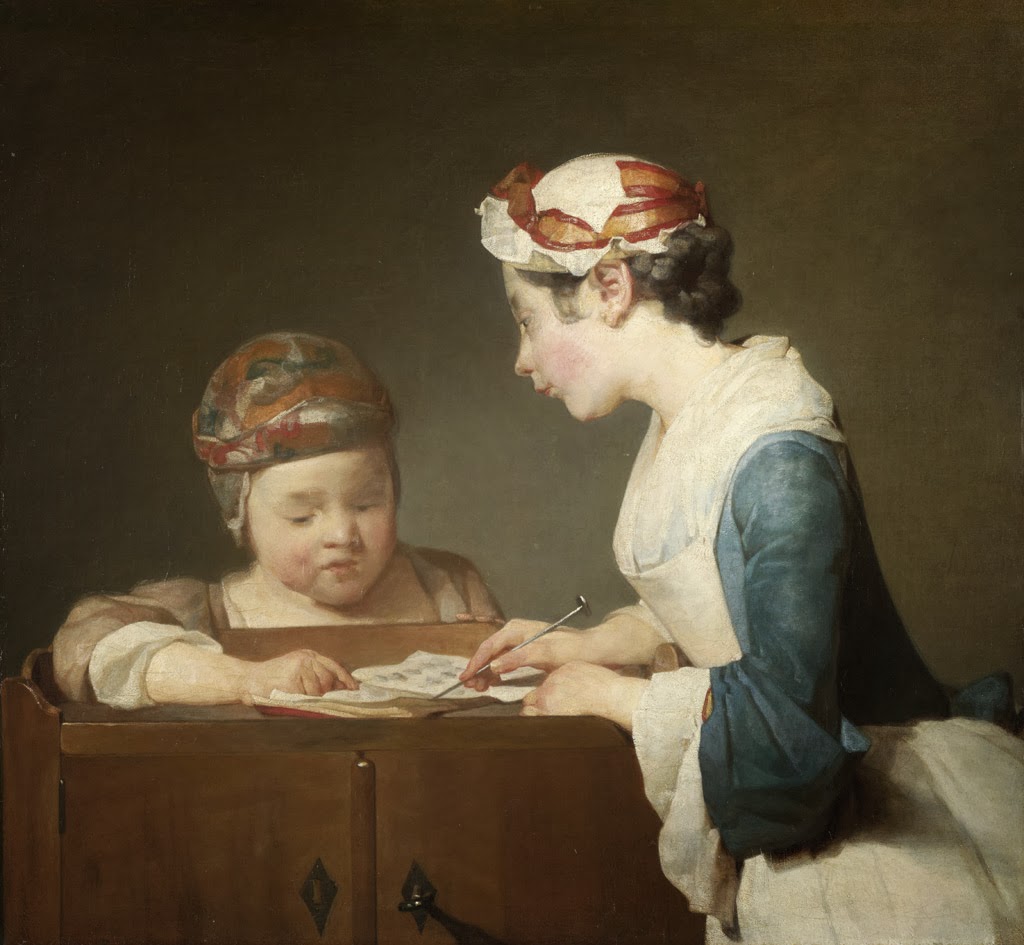
Freud is an artist with a highly recongisable voice. The best of his images of single figures are impressive and often poignant. But he is not really great artist. Let's get things in perspective.

Saturday, 5 October 2013
Leonardo and the supposed portrait of Isabella d'Este
Another promotion of a non-Leonardo, pushed by the Corriere della Serra, which has been a great newspaper. I was contacted by someone called ********** (removed at the request of the editor) - not, apparently, an accredited arts journalist. I declined to express a visual opinion on the basis of the poor reproductions I had seen but made it clear that any attribution to Leonardo was not consistent with the documentation. The result is that I am implicitly cited as a supporter of the attribution. I will be asking for a retraction. (note: they subsequently published an accurate interview with Francesca Pini, a very good arts journalist)
Having looked further at this, it is clear that the painting cannot be by Leonardo, on the basis of the documented account of Leonardo's relations with Isabella d'Este and his evident failure to paint her portrait. The documentation (in summary) runs as follows:
1) Leonardo made a finished drawing of Isabella when he was in Mantua in 1500. He left this behind in Mantua but Isabella's husband, Francesco Gonzaga, gave it away, much to her irritation. This is almost certainly the autograph cartoon partly coloured in chalk in the Louvre, which is pricked for transfer.
2) The studio made a revised version of the cartoon to take away with them (now in the Ashmolean Mus in Oxford), which was seen when Leonardo visited Venice. This was made from the Louvre cartoon, as the sploveri (dots of charcoal) confirm. The original cartoon has been revised to give more adequate room for the sitter's right arm, which is lowered, together with the ledge on which is rests and the book to which she points. The revised cartoon was taken back to Florence so that Leonardo could potentially make a painted version.
3) When Leonardo was back in Florence Isabella pestered him for 6 years for a painted version of the portrait or for any painting from his hand.
4) The correspondence suggests that she was not successful.
5) If Leonardo or the studio produced a portrait it would have been based on the revised version that they had with them not the one Alfonso had given away.
6) At some point the Louvre cartoon was cut down, with the loss of the ledge and book. This makes nonsense of her pointing gesture. The painting is based on the Louvre cartoon after its cutting down not on the Ashmolean one.
7) The crown and martyr's palm indicate that someone has used the Louvre cartoon to transform it into an image of Sta Barbara (as in Palma Vecchio's painting), or possibly of Santa Caterina.
Connoisseurship is not needed in this case. The documentation and evidence of the surviving drawings exclude the possibility that the painting can be by Leonardo.
Having looked further at this, it is clear that the painting cannot be by Leonardo, on the basis of the documented account of Leonardo's relations with Isabella d'Este and his evident failure to paint her portrait. The documentation (in summary) runs as follows:
1) Leonardo made a finished drawing of Isabella when he was in Mantua in 1500. He left this behind in Mantua but Isabella's husband, Francesco Gonzaga, gave it away, much to her irritation. This is almost certainly the autograph cartoon partly coloured in chalk in the Louvre, which is pricked for transfer.
2) The studio made a revised version of the cartoon to take away with them (now in the Ashmolean Mus in Oxford), which was seen when Leonardo visited Venice. This was made from the Louvre cartoon, as the sploveri (dots of charcoal) confirm. The original cartoon has been revised to give more adequate room for the sitter's right arm, which is lowered, together with the ledge on which is rests and the book to which she points. The revised cartoon was taken back to Florence so that Leonardo could potentially make a painted version.
3) When Leonardo was back in Florence Isabella pestered him for 6 years for a painted version of the portrait or for any painting from his hand.
4) The correspondence suggests that she was not successful.
5) If Leonardo or the studio produced a portrait it would have been based on the revised version that they had with them not the one Alfonso had given away.
6) At some point the Louvre cartoon was cut down, with the loss of the ledge and book. This makes nonsense of her pointing gesture. The painting is based on the Louvre cartoon after its cutting down not on the Ashmolean one.
7) The crown and martyr's palm indicate that someone has used the Louvre cartoon to transform it into an image of Sta Barbara (as in Palma Vecchio's painting), or possibly of Santa Caterina.
Connoisseurship is not needed in this case. The documentation and evidence of the surviving drawings exclude the possibility that the painting can be by Leonardo.
Friday, 9 August 2013
Security alert in Arab lands
The great palaver about anticipated attacks by Islamic militants, accompanied by the closure of embassies etc., is presented as a triumph for intelligent gathering via snooping on electronic communications. This is very convenient and timely for security agencies that have been attacked as the result of Snowden's disclosures. Let's set aside extreme scepticism and accept that the alert is not a contrived false alarm, we can still wonder if the trumpeting of the intelligence would have been the same at another time. The security agencies can't loose. If there are attacks, they can say, we told you so. If there are not, they can seek our acclaim for heading off the threats.
Leonardo and modern anatomy
I was hoping that we had passed beyond the "brownie-point" accounts of Leonardo's anatomical studies; that is to say valuing his work in terms of how far he was correct in terms of our present knowledge.
The item on Leonardo's anatomical drawings on the Today programme on BBC radio 4 was cast entirely in terms of how "modern" Leonardo's anatomies are. Once this has been accepted as the framework for judgements, the inevitable question follows. "What did Leonardo contribute to modern medicine?" "Ah.... actually nothing, since his work was not published, but it would have been the greatest had it been". Not direct quotes, but basically what was said. We can do better than this.
We are told, for instance, that Leonardo's use of sections anticipated CT and fMFRI scans. He did produce one early image of a leg cut into chunks like gigot chops, but the series of successive, very fine layers in modern scanning techniques actually grow of of 19th-century techniques of sectional anatomy presented on card or paper as extensive series of parallel slices. Leonardos use of sections (favouring solid over pure sections) can best be understood in terms of his use of innovatory use of sections in architectural studies and engineering - the sectioned dome of the human skull as the the sectioned dome of a temple - and his quest for three-dimensional visualizations that would present a total picture of the forms and functions of the body as a microcosm or "lesser world".
Leonardo's anatomies were not designed to perform the same function as the legions of sober illustrations in Henry Gray's Anatomy, Descriptive and Surgical. Leonardo's representations, like those in the great anatomical picture books that followed, were elaborate exercises in natural philosophy, displaying the magnificence of god's supreme creation, and the anatomist's mastery of it, rather than directly serving the standard needs of practicing physicians or even of operational surgeons. The grand and lavishly illustrated books of anatomy, from Vesalius's Fabrica (1543) onwards were not text books for general medical training but were aimed at patrons and wealthy academic and medical elites. The levels of knowledge of internal structures and functions displayed by Leonardo and Vesalius could not for the most part be directly exploited by medical techniques in the 16th century. Their demonstrations of the "fabric" of the body were directed towards quite another end than medical practice.
It is of course of interest and relevance to Leonardo's own aspirations to see what he "got right" and what he "got wrong". We can better understand Leonardo's studies when we know what he was looking at and how his kind of looking and representation resulted in the drawings and notes that have survived. But if our modern judgements of rightness and wrongness steer the system of values though which he look at his drawings, we are misunderstanding both the magnificent totality of his vision (in and beyond anatomy) and the historical context in which it was vibrant.
A good example of how we may approach Leonardo through contemporary medical eyes without asserting that such eyes present us with the way to understand his science is in Francis Well's recent book, The Heart of Leonardo. In my preface to his book I wrote that:
The item on Leonardo's anatomical drawings on the Today programme on BBC radio 4 was cast entirely in terms of how "modern" Leonardo's anatomies are. Once this has been accepted as the framework for judgements, the inevitable question follows. "What did Leonardo contribute to modern medicine?" "Ah.... actually nothing, since his work was not published, but it would have been the greatest had it been". Not direct quotes, but basically what was said. We can do better than this.
We are told, for instance, that Leonardo's use of sections anticipated CT and fMFRI scans. He did produce one early image of a leg cut into chunks like gigot chops, but the series of successive, very fine layers in modern scanning techniques actually grow of of 19th-century techniques of sectional anatomy presented on card or paper as extensive series of parallel slices. Leonardos use of sections (favouring solid over pure sections) can best be understood in terms of his use of innovatory use of sections in architectural studies and engineering - the sectioned dome of the human skull as the the sectioned dome of a temple - and his quest for three-dimensional visualizations that would present a total picture of the forms and functions of the body as a microcosm or "lesser world".
Leonardo's anatomies were not designed to perform the same function as the legions of sober illustrations in Henry Gray's Anatomy, Descriptive and Surgical. Leonardo's representations, like those in the great anatomical picture books that followed, were elaborate exercises in natural philosophy, displaying the magnificence of god's supreme creation, and the anatomist's mastery of it, rather than directly serving the standard needs of practicing physicians or even of operational surgeons. The grand and lavishly illustrated books of anatomy, from Vesalius's Fabrica (1543) onwards were not text books for general medical training but were aimed at patrons and wealthy academic and medical elites. The levels of knowledge of internal structures and functions displayed by Leonardo and Vesalius could not for the most part be directly exploited by medical techniques in the 16th century. Their demonstrations of the "fabric" of the body were directed towards quite another end than medical practice.
It is of course of interest and relevance to Leonardo's own aspirations to see what he "got right" and what he "got wrong". We can better understand Leonardo's studies when we know what he was looking at and how his kind of looking and representation resulted in the drawings and notes that have survived. But if our modern judgements of rightness and wrongness steer the system of values though which he look at his drawings, we are misunderstanding both the magnificent totality of his vision (in and beyond anatomy) and the historical context in which it was vibrant.
A good example of how we may approach Leonardo through contemporary medical eyes without asserting that such eyes present us with the way to understand his science is in Francis Well's recent book, The Heart of Leonardo. In my preface to his book I wrote that:
"Every drawing by Leonardo is simultaneously
act of analysis as well as description. He cannot draw a form without
intuitions about its function. To ascertain how a form works – with no deficiency
or redundancy – he brings his knowledge of dynamics to bear on his accounts of
structures in motion. He knows about weights, levers and pulleys, which he can
apply to the functioning of the body. The skeleton and muscles serve as a
compound machine, the mathematical trajectory of which enables humans to move
their limbs with complete freedom in space – across what he calls a “continuous
quality”. The complex motion of fluids, above all water, to which he devoted
minute and exhaustive attention, becomes vital to his reading of the actions of
the heart valves, which he shows to be miracles of geometrical engineering. He cannot see what blood does in the valves,
but he can transfer his knowledge of water vortices. He is a natural
bio-engineer. Indeed, his plan to make a glass model of the neck of an aorta to
test his notion of the internal currents of blood is entirely novel. He is
determined to invent means to determine the “impetus” and “percussion” of the
surging torrents of blood, even if he cannot see them first-hand within the
heart.
"We do not have to validate Leonardo’s science in terms of contemporary
knowledge, nor do we have to evaluate
it by adducing its influence on the history of medicine. His visions of the
human body and the body of the earth possess a beauty of insight that are
uplifting in their own right, to no lesser degree than his works of art. And
they stand as an enduring monument to an unconstrained quest for understanding across
disciplines. However, it is thrilling to find that he can still conduct a
creative dialogue with a major heart surgeon over the span of 500 years.
Francis Wells brings his clinical eye to bear upon drawings we have long admired,
and points out major features that we little understood and telling details
that we had entirely missed. He shows
that no organ had ever been subjected to such remorseless visual enquiry and
functional interrogation as Leonardo devoted to the heart."
I am sorry that I mentioned bio-engineering. But most of if seems OK.
Subscribe to:
Posts (Atom)